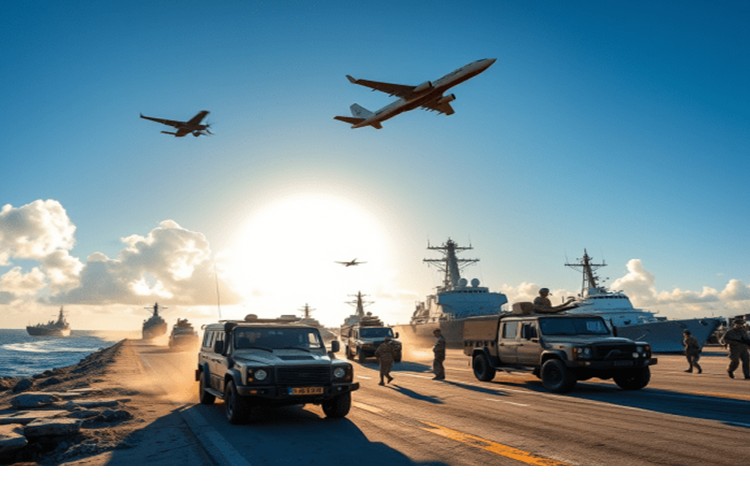
The United States is undertaking one of its most significant military build-ups in the Caribbean in decades, escalating tensions with Venezuela, and reshaping regional geopolitics. This article will try to explain the US military build-up in the Caribbean.
The Scale of the Deployment
The US military presence in the Caribbean has expanded dramatically under Operation Southern Spear, announced earlier this month. Thousands of Marines, advanced naval vessels, and the world’s most modern aircraft carrier have been positioned just miles off Venezuela’s coast.
This marks the most significant deployment in the region since the Cold War, signaling Washington’s intent to project overwhelming force.
Satellite imagery and reports confirm that US forces are not only conducting anti-narcotics operations but also positioning strategically near Venezuela’s northern coast. The Pentagon insists the mission is aimed at dismantling “narco-terrorist” networks, but analysts argue the build-up is clearly designed to pressure President Nicolás Maduro’s government.
Strategic Objectives
While the official narrative emphasizes drug interdiction, experts suggest broader goals. According to military documents, the US plans to maintain a heavy presence in the Caribbean through at least 2028.
This long-term strategy points to ambitions beyond counter-narcotics, including regime change in Venezuela and influence over other left-leaning governments in the Caribbean Basin. Counterpunch.
The Trump administration has revived a hemispheric doctrine—dubbed the “Donroe Doctrine” by some observers—that seeks to ensure US dominance in the Western Hemisphere. By stationing forces so close to Venezuela, Washington is signaling that it will not tolerate governments it deems hostile or destabilizing.
Diplomatic Maneuvers
Parallel to the military escalation, top US officials are touring the Caribbean to reassure allies and secure cooperation. Defense Secretary Pete Hegseth met with Dominican Republic leaders this week, while Joint Chiefs Chairman General Dan Caine visited Puerto Rico and US naval forces stationed nearby, Al Jazeera.
These visits underscore the dual track of military pressure and diplomatic outreach.
Caribbean nations, many of which rely on US trade and security guarantees, face difficult choices. Aligning with Washington could bring economic and military support, but risks entanglement in a confrontation with Venezuela.
Regional Reactions
The build-up has sparked alarm across Latin America. Venezuela has condemned the deployments as preparation for aggression, while sympathetic governments warn of destabilization. Critics argue that the anti-drug justification masks a broader campaign of interventionism.
At the same time, some Caribbean leaders welcome US involvement, citing the persistent threat of narcotics trafficking and organized crime. The region has long struggled with smuggling routes that connect South America to North America, and Washington’s military presence could disrupt these networks.
Risks and Consequences
The escalation carries significant risks. A miscalculation at sea or in the air could trigger confrontation between US and Venezuelan forces. Moreover, the perception of US interventionism could fuel anti-American sentiment across Latin America, undermining Washington’s diplomatic standing.
Long-term stationing of troops and warships also raises questions about sovereignty and militarization of the Caribbean. If the US maintains forces through 2028, as documents suggest, the region could become a permanent theater of geopolitical competition.
Conclusion
As of today, the US military build-up in the Caribbean represents a turning point in hemispheric relations. Officially framed as a campaign against narcotics, the deployment is widely seen as a bid to pressure Venezuela and reassert US dominance in the region.
With thousands of Marines, advanced naval assets, and high-level diplomatic visits, Washington is signaling its intent to remain the preeminent power in the Caribbean Basin.
The coming months will reveal whether this strategy deters adversaries or provokes confrontation. Either way, the Caribbean has once again become a frontline in the contest for influence in the Americas.
By :Staff
 Christian Briefs